· Classical
How to listen and understand contemporary music?
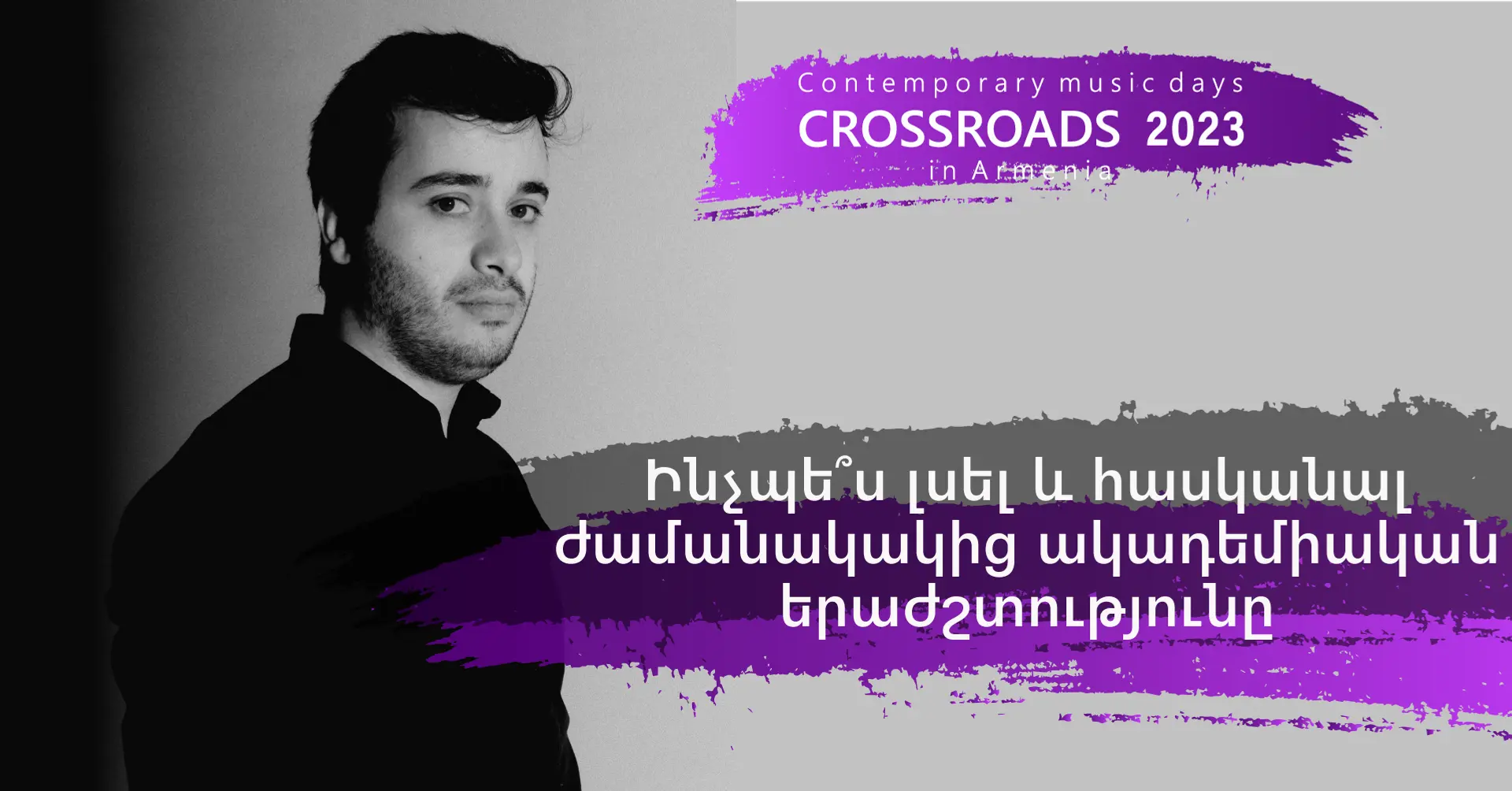
This year "Crossroads: Contemporary music days in Armenia" international festival will be held on April 3-26. Within the festival, 7 concerts will be presented in Yerevan and in Gyumri. See the full program following the link: https://bit.ly/3njFGxU․
In regard to the issue, consider how a listener who has no musical education and frequently enters a concert hall expecting to hear something else can become more prepared, knowledgeable, and capable of listening to and understanding contemporary music.
Contemporary music is a type of musical expression that emerged in the twentieth century and incorporates elements from both classical and modern forms. It can encompass a wide range of musical styles, including pop, jazz, and rock music, as well as ethnic and classical music. However, Contemporary music is not widely available, and it is frequently difficult to understand. However, there are various measures that can be taken to help the listener grasp what they hear and see.
The first step before attending a concert is to learn about the composer, what works he or she has written, and what musical direction or directions has in works.
Knowing composers and their creative techniques will allow you to listen to concert performances and compositions with greater interest, distinguishing serialism from minimalism, spectralism from postmodernism, and so on.
The second phase will let you enjoy the concert even more by familiarizing yourself with acoustic, electronic, and sound production instruments. There can be both classical instruments (violin, cello, flute, clarinet, piano, etc.) and electronic instruments, ranging from analog synthesizers to digital sound reproduction devices, which are created using DAW (computer programs for working with digital sound), as well as very new acoustic instruments created by composers or sound artists, which may become as widely applicable and as classic as the violin in the coming years.
The third phase is to become acquainted with the methods and processes of music composition, as well as, if possible, to participate in them. The compositional method is a body of knowledge that allows an author to express his or her thoughts through speech or vocalization. Even for educated musicians, they can be quite complex and difficult to comprehend, but without a grasp of them, it is difficult to understand the visual, often seemingly bizarre gestures have done on stage, such as playing the strings of a piano...
When we become more conscious of all of this while listening, we begin to observe the link between tones and actions with curiosity, and their perception becomes easier and more understandable.
Composers or sound artists frequently make installations or interactive musical performances in which the interested listener can engage in the ongoing processes, affect them with their own actions, and enjoy the entire process while getting a valuable experience.
You will begin to see things from different angles and discriminate between good and terrible music without even knowing whose great composer you are listening to at the time. And, of course, the most essential thing is that when you go to concerts, you will not consider your time spent since you will comprehend everything that happens on stage and, more importantly, you will become a participant in the entire process.
Sergey Umroyan
Composer, producer
In regard to the issue, consider how a listener who has no musical education and frequently enters a concert hall expecting to hear something else can become more prepared, knowledgeable, and capable of listening to and understanding contemporary music.
Contemporary music is a type of musical expression that emerged in the twentieth century and incorporates elements from both classical and modern forms. It can encompass a wide range of musical styles, including pop, jazz, and rock music, as well as ethnic and classical music. However, Contemporary music is not widely available, and it is frequently difficult to understand. However, there are various measures that can be taken to help the listener grasp what they hear and see.
The first step before attending a concert is to learn about the composer, what works he or she has written, and what musical direction or directions has in works.
Knowing composers and their creative techniques will allow you to listen to concert performances and compositions with greater interest, distinguishing serialism from minimalism, spectralism from postmodernism, and so on.
The second phase will let you enjoy the concert even more by familiarizing yourself with acoustic, electronic, and sound production instruments. There can be both classical instruments (violin, cello, flute, clarinet, piano, etc.) and electronic instruments, ranging from analog synthesizers to digital sound reproduction devices, which are created using DAW (computer programs for working with digital sound), as well as very new acoustic instruments created by composers or sound artists, which may become as widely applicable and as classic as the violin in the coming years.
The third phase is to become acquainted with the methods and processes of music composition, as well as, if possible, to participate in them. The compositional method is a body of knowledge that allows an author to express his or her thoughts through speech or vocalization. Even for educated musicians, they can be quite complex and difficult to comprehend, but without a grasp of them, it is difficult to understand the visual, often seemingly bizarre gestures have done on stage, such as playing the strings of a piano...
When we become more conscious of all of this while listening, we begin to observe the link between tones and actions with curiosity, and their perception becomes easier and more understandable.
Composers or sound artists frequently make installations or interactive musical performances in which the interested listener can engage in the ongoing processes, affect them with their own actions, and enjoy the entire process while getting a valuable experience.
You will begin to see things from different angles and discriminate between good and terrible music without even knowing whose great composer you are listening to at the time. And, of course, the most essential thing is that when you go to concerts, you will not consider your time spent since you will comprehend everything that happens on stage and, more importantly, you will become a participant in the entire process.
Sergey Umroyan
Composer, producer